
Strikethrough prices and comparative prices have a significant impact on customer purchasing behavior. This article examines the legal requirements governing the use of comparative and reference prices and provides guidance on their psychologically optimal presentation (“price marketing”).
In this article, we will look at what is meant by “strike prices” in retail and e-commerce, why they make sense, how they work psychologically, and how the presentation of strike prices can be optimized.
Disclaimer: This article does not replace legal advice. The contents were created with the greatest care and are intended to give you helpful impulses – however, they do not constitute legal advice. If you have legal questions about a specific case, please contact a lawyer you trust.
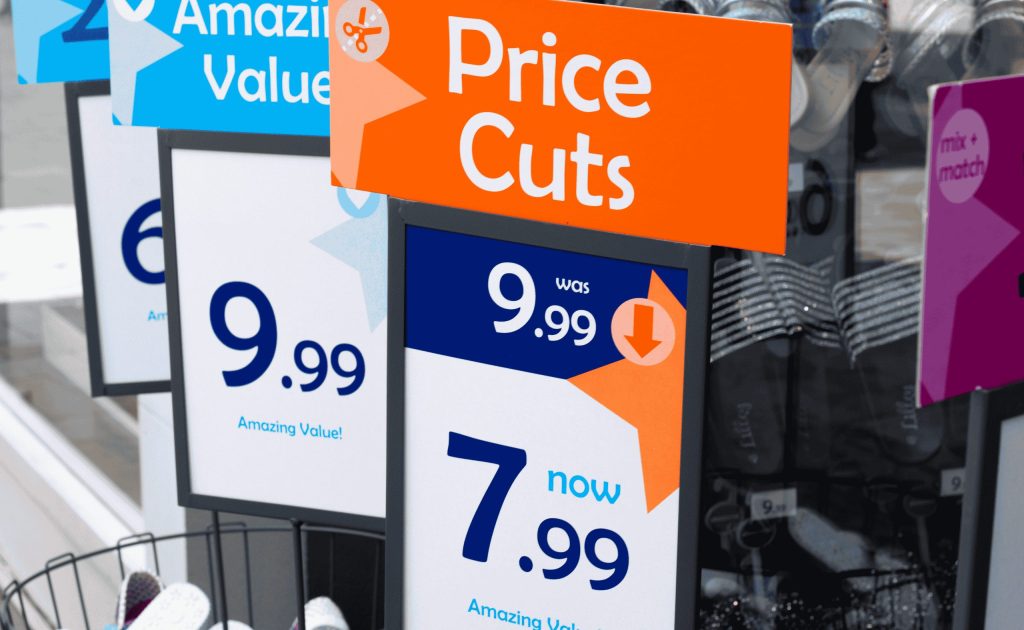
Is a price of EUR 99 good? In any case, it is perceived as cheaper if it is next to a crossed-out, higher “instead of price.” This “instead of price” is a so-called strike price, which is also often graphically crossed out. The strike price serves as a reference price, against which customers compare the actual price. This active communication of price advantages and rebates (price discount advertising) is also referred to as price marketing.
A saving presented in this way significantly improves the price-performance ratio perceived by customers. The perception changed by strike prices ultimately increases the probability of purchase. Since this effect is relatively strong, there could be an incentive on the part of retailers to specify an inadmissible, artificially generated strike price that is intended to influence customer behavior.
In order to avoid misleading advertising and the presentation of price reductions, the legislator has established corresponding regulations for consumer protection. These regulations can be found, for example, in the Law Against Unfair Competition (UWG).
The fact that the legislator regulates the presentation of strike prices can be interpreted to mean that strike prices in price advertising have a proven effect on consumers.
The Price Indication Regulation (PAngV) “(…) regulates the indication of prices for goods or services by businesses to consumers.” (§ 1 Abs. 1 PAngV). The Price Indication Regulation is the transposition of European law into national law.
The revision of the Price Indication Ordinance on 28.08.2022 is due to the so-called EU Omnibus Directive 2019/2161 – or in the long name:
Directive (EU) 2019/2161 of the European Parliament and of the Council of 27 November 2019 amending Council Directive 93/13/EEC and Directives 98/6/EC, 2005/29/EC and 2011/83/EU of the European Parliament and of the Council as regards better enforcement and modernisation of Union consumer protection rules
A central area of regulation is the presentation of price discounts in retail and e-commerce.
The EU Omnibus Directive contains the following regulations:
“Directive 98/6/EC is amended as follows: The following Article is inserted: Article 6a
(1) Any announcement of a price reduction shall indicate the prior price applied by the trader for a specified period before the price reduction.
(2) The prior price is the lowest price applied by the trader within a period of at least 30 days before the application of the price reduction. (…)”
These regulations were implemented in German law in § 11 PAngV (“Additional price indication obligation for price reductions for goods”) for retail and e-commerce as follows.
“(1) Anyone who is obliged to indicate a total price must, vis-à-vis consumers, indicate the lowest total price that he has applied within the last 30 days prior to the application of the price reduction vis-à-vis consumers for each announcement of a price reduction for a good.”
“(2) In the case of a gradual, uninterruptedly increasing price reduction of the total price of a good, the lowest total price according to paragraph 1 that was applied to consumers for this good before the start of the gradual price reduction can be indicated for the duration of the price reduction.”
This means that price savings may be compared to the lowest price of the last 30 days. If the sales price is continuously reduced in stages – e.g. as part of markdown pricing – the lowest price of the last 30 days before the first price reduction stage can continue to be displayed for all subsequent reductions.
This regulation leads us to the first option of strike prices, comparison prices or (external) reference prices.
The “instead of” price is the price that is displayed as the original price in the event of a price reduction: instead of EUR 119, now EUR 99, you save EUR 20 (or 17%).
The PAngV requires that the lowest price of the last 30 days be displayed as a strike or comparison price for price reductions.
If a comparison price is presented as crossed out, a price reduction is generally assumed. The Federal Court of Justice has made this assessment (BGH I ZR 182/14).
What happens if the lowest price of the last 30 days is not advertised as crossed out?
The Baden-Württemberg Consumer Advice Centre has initiated a warning against Amazon and accused the online retailer of the practices in the presentation of strike prices.
In the case law of the Munich Regional Court dated July 14, 2025 (LG Munich I, Case No. 4 HK O 13950/24) against Amazon, the following judgment was rendered:”
“The defendant is ordered to refrain from offering consumers the purchase of electronic devices on the Internet, stating a percentage price reduction (“-19%”) and a crossed-out price (“€259.00”), if neither the percentage reduction nor the crossed-out price refer to the lowest total price that the defendant has applied to consumers within the last 30 days before the application of the price reduction, but to an “MSRP” of the manufacturer.” (Page 2)
“The defendant is further ordered to refrain from advertising to consumers for the sale of consumer electronics items with the granting of a “discount” (“19% discount”) (…), if this discount does not refer to the reduction of a total price previously demanded by the defendant, but merely expresses the amount by which an “MSRP” stated by the manufacturer is undercut (…).” (Page 3)
Amazon was threatened with “(…) a fine of up to €250,000 for each case of culpable violation of one of the (…) aforementioned injunctive obligations (alternatively, imprisonment for up to 6 weeks) or imprisonment for up to 6 months, to be enforced against the managing director of the defendant.” (Page 4)
Conclusion: Strike prices and price reductions in retail and e-commerce must refer to the lowest price of the last 30 days before the advertised price reduction.
What role does the Manufacturer’s Suggested Retail Price (MSRP) play? The MSRP refers to a non-binding price recommendation from the product manufacturer for retail and e-commerce.
The comparison of a price with an MSRP is still possible and is referred to as a “third-party price comparison,” as long as the presentation of the price comparison cannot be understood as a price reduction. The above-mentioned Amazon judgment states:
“It is to be assessed on the basis of the specific design of the advertising whether, according to consumer perception, it represents a mere third-party price comparison or an announcement of an own-price reduction or a combination of both.
Based on the relevant circumstances of the individual case at hand, it must be assumed in all three challenged cases that the advertising is part of a presentation made up as price reduction advertising and is understood accordingly by the reference consumer.” (Pages 7-8)
Conclusion: A price can be compared to the MSRP, provided that no price reduction is inferred.
When customers and consumers look at a price, they compare this price with their price perception for a reasonable price. This price perception is also referred to as the internal reference price.
If the price on the price tag is above the internal reference price, the price is perceived as high or expensive. If the price is below it, it is perceived as cheap or inexpensive.
However, we as consumers find it difficult to assess a price without a direct comparison. We humans cannot assess sizes expressed in numbers – such as prices – so well individually. We are better at evaluating these sizes relative to something else.
This is where so-called external reference prices come into play, which are presented to the customer and serve as a benchmark. These external reference prices are, for example, the lowest price of the last 30 days or the Manufacturer’s Suggested Retail Price (MSRP).
These external reference prices influence price perception in two ways.
First, customers perceive this external reference price and compare it with the internal reference price. If the external reference price is credible, it raises the internal reference price, so that the assessment of what is a reasonable price increases. This is an example of displaying the MSRP. The opposite is the case if the external reference price is lower than the internal reference price: Customers then expect a lower reasonable price.
Second, customers infer a perceived saving from the difference between a higher external reference price and a lower current price. This perceived saving has a value in itself from the customer’s point of view. You are not only happy about the product you bought, but also about the saving – in this case, we speak of an additional transaction benefit.
How can this perceived saving be influenced by presenting your own price with a comparison price? This is a topic of price psychology.
The following explanations also apply to actual price reductions as part of a discount campaign. However, in the following, we assume that you have had a good price for more than 30 days, but are not planning any further price reductions. Nevertheless, you would like to point out this objectively good price to your customers. Your selling price (VKP) is significantly below the Manufacturer’s Suggested Retail Price (MSRP) of the manufacturer.
What psychological principles should you consider when presenting your price information?
If you would like to speak to an expert about your price communication without obligation, please arrange a meeting with us.
PMI Newsletter
Receive regular first access to:
You are currently viewing a placeholder content from Vimeo. To access the actual content, click the button below. Please note that doing so will share data with third-party providers.
More InformationYou are currently viewing a placeholder content from YouTube. To access the actual content, click the button below. Please note that doing so will share data with third-party providers.
More InformationYou need to load content from reCAPTCHA to submit the form. Please note that doing so will share data with third-party providers.
More Information